

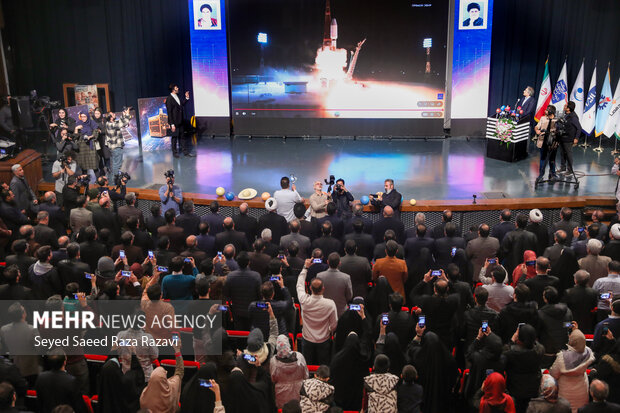
Iran first entered the space arena on February 2, 2009, with the successful launch of its domestically developed “Omid” (Hope) satellite. The satellite remained operational in orbit for nearly three months before completing its mission.
Following this milestone, Iran’s Supreme Council of Public Culture officially designated the anniversary of the Omid launch as National Space Technology Day.
Despite international sanctions, Iran has emerged as one of the leading space-capable countries in the region, relying on indigenous expertise and domestic technology. The country has developed a complete satellite lifecycle—from design and manufacturing to launch—an achievement previously limited to roughly 10 countries worldwide.
Space technology now plays a critical role in disaster management, environmental monitoring and various aspects of modern life. Investment in this sector has proven economically and strategically valuable, prompting even developing nations to pursue space programs as part of long-term national planning.
In this context, Iran is set to unveil new space-related projects, including a satellite, satellite imagery products and a new space base, as part of this year's National Space Technology Day commemorations.
Hassan Salarieh, Head of the Iran Space Agency, told Mehr News Agency that plans are underway to launch satellites and inaugurate new space projects before the end of the current Iranian calendar year.
He said the main prototype of the “Martyr Soleimani” satellite constellation will be unveiled for the first time on National Space Technology Day, adding that Iran is also seeking to conduct satellite launches using domestic launch vehicles, including from the Chabahar space facility.
Salarieh emphasized that satellite launches require extensive technical preparations, including compatibility tests between the satellite and the launch vehicle, delivery procedures, and final pre-launch evaluations.
“These processes are time-consuming but essential,” he said, noting that all technical stages must be completed with precision to ensure a safe and reliable launch.
He added that preparations for conducting launches from the Chabahar space base are ongoing, and once the satellite and launch vehicle are fully ready, the first launch from the site will take place.
Salarieh explained that in the space industry, launch dates are often not announced in advance due to the need for comprehensive testing and strict quality control, aimed at avoiding rushed operations and ensuring mission success.
MNA/6736562
 20:16 - 2026/02/02

















Your Comment